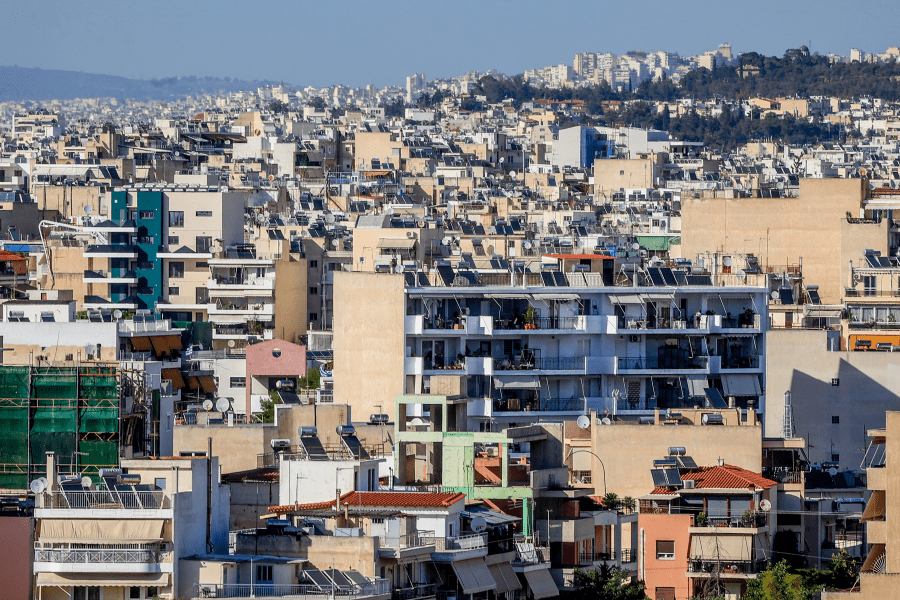

To stand on Mount Lycabettus and look out over the Athenian basin is to view a seemingly endless, homogenous sea of flat-roofed, white concrete buildings. For expatriates and digital nomads arriving in the capital, this dense architectural uniformity often presents a stark contrast to the manicured historical centers of other European cities. Yet, this concrete sprawl is neither a historical accident nor the result of master urban planning. It is the living legacy of antiparochi—a uniquely Greek economic mechanism that solved a post-war housing crisis, fueled an economic miracle, and permanently dictated the shape of the city.
To understand the current friction in the Athenian real estate market, one must understand the bricks and mortar that built it. The history of how the city grew is the ultimate key to deciphering why renting or renovating an apartment in 2026 feels the way it does.
The Birth of a State-Free Solution
In the aftermath of World War II and the brutal Greek Civil War, Athens experienced an overwhelming wave of internal migration. Hundreds of thousands of rural citizens flocked to the capital seeking security and employment. The Greek state, financially exhausted, possessed neither the capital nor the institutional capacity to initiate large-scale public housing projects like those seen in post-war Britain or Germany.
The Mechanics of the Land Exchange
The solution that emerged in the 1950s was brilliantly simple and relied entirely on private capital: the antiparochi (mutual exchange) system. Under this model, an owner of a small plot of land or a single-story neoclassical house would hand over their property to a private contractor.

In exchange for the land, the contractor would finance and build a multi-story apartment building at their own expense. Upon completion, the original landowner was given a negotiated share of the finished apartments—typically two or three units—while the contractor sold the remaining flats for profit. This mechanism entirely bypassed the need for bank loans, which were practically non-existent for the average citizen at the time. It weaponized small-scale private property to fund mass construction, turning Athens into a vast, decentralized construction site driven by individual handshake agreements.
The Anatomy of the Polykatoikia
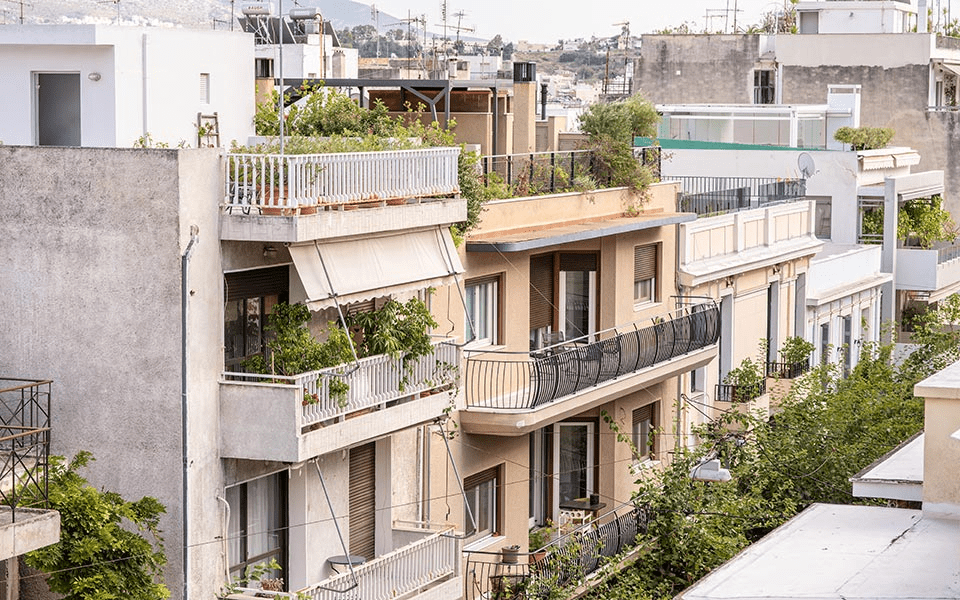
The direct physical result of the antiparochi boom was the proliferation of the polykatoikia (multi-apartment building). These standardized concrete blocks now dominate nearly every neighborhood, from Pangrati to Kypseli. They were erected rapidly, utilizing repetitive layouts designed to maximize the profitable square footage of every given plot, often at the expense of green spaces and wide sidewalks.
Vertical Social Segregation
Interestingly, the antiparochi system inadvertently created a unique sociological layout within the capital. Because these buildings were constructed plot-by-plot rather than in sprawling, economically segregated suburban developments, different socioeconomic classes found themselves living under the same roof.
The wealthy occupied the highly desirable top-floor penthouses—the retire—which boasted large, wraparound balconies and city views. The middle class inhabited the middle floors, while the working class, students, and new migrants rented the cheaper, darker semi-basements and ground-floor units. This vertical integration prevented the creation of the isolated poverty slums that plagued other rapidly expanding global cities during the same era, embedding a deep, chaotic sense of community into the Athenian geitonia (neighborhood).
The Legacy We Live in Today
While antiparochi successfully housed a displaced population and built a robust middle class, the long-term urban costs were severe. To make way for profitable concrete blocks, the vast majority of Athens’ beautiful neoclassical housing stock was demolished.
Today, the vast majority of these polykatoikies are between fifty and seventy years old. They suffer from systemic energy inefficiency, lacking modern insulation, double-glazed windows, and relying on outdated central oil heating systems.
This introduces the modern resident to the harsh reality of kinoxrista—the communal building expenses. Because the antiparochi system distributed ownership of a single building among multiple, disparate individuals, upgrading the infrastructure requires a majority consensus among the various apartment owners. Securing this agreement is notoriously difficult. Consequently, buildings often fall into disrepair, and winter heating bills can become astronomical as residents pay the price for mid-century concrete construction.
What This Means for Renters and Buyers in 2026
For the modern renter or investor navigating Athens today, the legacy of antiparochi is not just architectural history; it is a daily financial reality.
When touring an apartment, the aesthetic appeal of a renovated interior often masks the structural reality of the building it sits within. A highly modernized flat in a 1960s polykatoikia with a decaying roof and a dysfunctional central boiler will still saddle the tenant with high kinoxrista and severe winter utility bills.
The current real estate squeeze in Athens is heavily defined by this aging stock. The market premium is no longer just about neighborhood location; it is increasingly about energy efficiency and the operational health of the building. Expats and locals alike are learning that surviving the capital’s cost-of-living crisis requires looking past the fresh coat of paint and understanding the mid-century concrete bones of the city.